
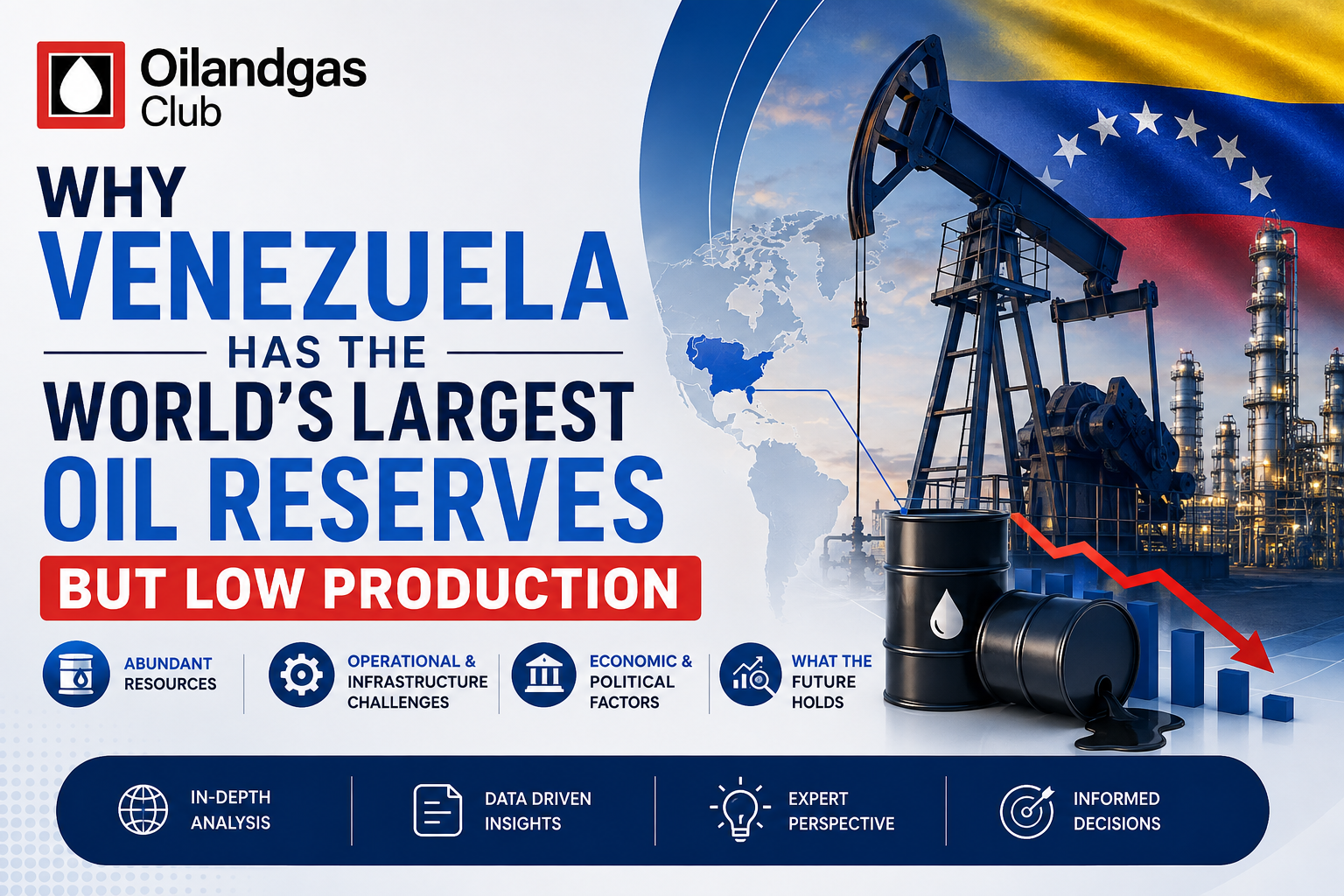
Why Venezuela Has the World’s Largest Oil Reserves but Low Production

Why Venezuela Has the World’s Largest Oil Reserves but Low Production

Venezuela’s Oil Reserves at a Glance

Venezuela’s oil reserves are primarily located in the Orinoco Heavy Oil Belt, one of the largest hydrocarbon accumulations ever discovered.
CountryProven Oil Reserves (Billion Barrels)
Venezuela~303
Saudi Arabia~267
Iran~208
Iraq~145
Russia~108

📌 Source: OPEC / EIA

Despite ranking #1 in reserves, Venezuela does not rank anywhere near the top in production.


Venezuela Oil Production: A Sharp Decline

Oil Production Trend (Barrels per Day)
YearProduction (Million bpd)
19983.4
20102.5
20152.3
20181.3
20200.6
2023~0.8
📉 Production has dropped by over 75% since its peak.

Heavy Crude Oil: The Biggest Technical Challenge

Most Venezuelan oil is extra-heavy crude, which creates several production challenges:

  • Very high viscosity

  • Requires thermal recovery or dilution

  • Needs upgrading before refining

  • Higher operating and capital costs

Unlike light crude oil, heavy oil cannot flow easily and requires advanced technology and continuous investment.

Collapse of PDVSA

Venezuela’s national oil company, Petróleos de Venezuela S.A. (PDVSA), was once a global leader in oil operations.

Today, it faces:

  • Aging and failing infrastructure

  • Severe maintenance backlogs

  • Loss of experienced engineers

  • Political interference in technical decisions

Without reinvestment, oil fields naturally decline—and in Venezuela, that decline accelerated rapidly.

Political Decisions and Nationalization

Under Hugo Chávez, the oil industry shifted focus from reinvestment to social spending.

Key impacts:

  • Reduced capital for drilling and maintenance

  • Contract instability for foreign partners

  • Nationalization of major oil projects

These policies reduced foreign investment and slowed technological progress.

Sanctions and Market Isolation

International sanctions—especially from the U.S.—further restricted Venezuela’s oil sector by:

  • Limiting access to financing

  • Blocking imports of diluents and spare parts

  • Restricting oil exports and payments

Even when oil is produced, selling it becomes difficult.

Infrastructure and Refinery Failures

Oil production depends on supporting systems:

  • Power supply

  • Pipelines

  • Storage tanks

  • Refineries

In Venezuela:

  • Refineries run far below capacity

  • Power outages halt production

  • Pipelines suffer leaks and corrosion

Without infrastructure reliability, production cannot recover.

OPEC Membership Is Not Enough

Venezuela is a founding member of OPEC, but OPEC cannot fix internal problems.

Venezuela often produces below its OPEC quota—not by choice, but due to operational limits.

Loss of Skilled Workforce

Thousands of engineers and technicians have left Venezuela due to:

  • Low wages

  • Economic instability

  • Poor working conditions

Heavy oil operations require highly skilled personnel. Losing them severely impacts production.

Reserves vs Production: Key Industry Lesson

Large oil reserves do not guarantee high production.

To convert reserves into barrels per day, a country needs:

  • Stable policies

  • Continuous investment

  • Skilled workforce

  • Modern technology

  • Access to global markets

Venezuela lacks several of these today.

Can Venezuela Recover Oil Production?

Technically, yes—but recovery requires:

  • Massive reinvestment in PDVSA

  • Policy reforms and stability

  • Sanctions relief

  • Foreign partnerships

  • Rebuilding engineering talent

Such recovery would take years, not months.

Conclusion

Venezuela’s oil crisis is not geological—it is economic, political, and technical. The country stands as a powerful reminder that oil reserves alone do not ensure energy dominance.

For engineers and energy professionals, Venezuela is a real-world case study of how governance and investment directly impact production performance.

Technical reasons for low recovery factors in Orinoco heavy oil:

  • Poor mobility ratio

  • Limited thermal EOR deployment

  • Diluent supply constraints

  • Upgrader bottlenecks

Typical Recovery Factor:

  • Heavy oil fields: 8–12%

  • Light oil fields: 30–40%

Venezuela’s Oil Reserves at a Glance

Venezuela’s oil reserves are primarily located in the Orinoco Heavy Oil Belt, one of the largest hydrocarbon accumulations ever discovered.
CountryProven Oil Reserves (Billion Barrels)
Venezuela~303
Saudi Arabia~267
Iran~208
Iraq~145
Russia~108

📌 Source: OPEC / EIA

Despite ranking #1 in reserves, Venezuela does not rank anywhere near the top in production.


Venezuela Oil Production: A Sharp Decline

Oil Production Trend (Barrels per Day)
YearProduction (Million bpd)
19983.4
20102.5
20152.3
20181.3
20200.6
2023~0.8
📉 Production has dropped by over 75% since its peak.

Heavy Crude Oil: The Biggest Technical Challenge

Most Venezuelan oil is extra-heavy crude, which creates several production challenges:

  • Very high viscosity

  • Requires thermal recovery or dilution

  • Needs upgrading before refining

  • Higher operating and capital costs

Unlike light crude oil, heavy oil cannot flow easily and requires advanced technology and continuous investment.

oilandgasclub
Oil & Gas Fundamentals Course

Complete Oil and Gas Industry Practical Training Course

Complete Oil and Gas Industry Practical Training Course is a self-learning, practical program powered by industry expertise.

  • pipenet
  • HTRI
  • pipesim
  • olga
Learn more

Collapse of PDVSA

Venezuela’s national oil company, Petróleos de Venezuela S.A. (PDVSA), was once a global leader in oil operations.

Today, it faces:

  • Aging and failing infrastructure

  • Severe maintenance backlogs

  • Loss of experienced engineers

  • Political interference in technical decisions

Without reinvestment, oil fields naturally decline—and in Venezuela, that decline accelerated rapidly.

Political Decisions and Nationalization

Under Hugo Chávez, the oil industry shifted focus from reinvestment to social spending.

Key impacts:

  • Reduced capital for drilling and maintenance

  • Contract instability for foreign partners

  • Nationalization of major oil projects

These policies reduced foreign investment and slowed technological progress.

Sanctions and Market Isolation

International sanctions—especially from the U.S.—further restricted Venezuela’s oil sector by:

  • Limiting access to financing

  • Blocking imports of diluents and spare parts

  • Restricting oil exports and payments

Even when oil is produced, selling it becomes difficult.

oilandgasclub
Oil & Gas Fundamentals Course

Complete Oil and Gas Industry Practical Training Course

Complete Oil and Gas Industry Practical Training Course is a self-learning, practical program powered by industry expertise.

  • pipenet
  • HTRI
  • pipesim
  • olga
Learn more

Infrastructure and Refinery Failures

Oil production depends on supporting systems:

  • Power supply

  • Pipelines

  • Storage tanks

  • Refineries

In Venezuela:

  • Refineries run far below capacity

  • Power outages halt production

  • Pipelines suffer leaks and corrosion

Without infrastructure reliability, production cannot recover.

OPEC Membership Is Not Enough

Venezuela is a founding member of OPEC, but OPEC cannot fix internal problems.

Venezuela often produces below its OPEC quota—not by choice, but due to operational limits.

Loss of Skilled Workforce

Thousands of engineers and technicians have left Venezuela due to:

  • Low wages

  • Economic instability

  • Poor working conditions

Heavy oil operations require highly skilled personnel. Losing them severely impacts production.

oilandgasclub
Oil & Gas Fundamentals Course

Complete Oil and Gas Industry Practical Training Course

Complete Oil and Gas Industry Practical Training Course is a self-learning, practical program powered by industry expertise.

  • pipenet
  • HTRI
  • pipesim
  • olga
Learn more

Reserves vs Production: Key Industry Lesson

Large oil reserves do not guarantee high production.

To convert reserves into barrels per day, a country needs:

  • Stable policies

  • Continuous investment

  • Skilled workforce

  • Modern technology

  • Access to global markets

Venezuela lacks several of these today.

Can Venezuela Recover Oil Production?

Technically, yes—but recovery requires:

  • Massive reinvestment in PDVSA

  • Policy reforms and stability

  • Sanctions relief

  • Foreign partnerships

  • Rebuilding engineering talent

Such recovery would take years, not months.

Conclusion

Venezuela’s oil crisis is not geological—it is economic, political, and technical. The country stands as a powerful reminder that oil reserves alone do not ensure energy dominance.

For engineers and energy professionals, Venezuela is a real-world case study of how governance and investment directly impact production performance.

oilandgasclub
Oil & Gas Fundamentals Course

Complete Oil and Gas Industry Practical Training Course

Complete Oil and Gas Industry Practical Training Course is a self-learning, practical program powered by industry expertise.

  • pipenet
  • HTRI
  • pipesim
  • olga
Learn more

Technical reasons for low recovery factors in Orinoco heavy oil:

  • Poor mobility ratio

  • Limited thermal EOR deployment

  • Diluent supply constraints

  • Upgrader bottlenecks

Typical Recovery Factor:

  • Heavy oil fields: 8–12%

  • Light oil fields: 30–40%