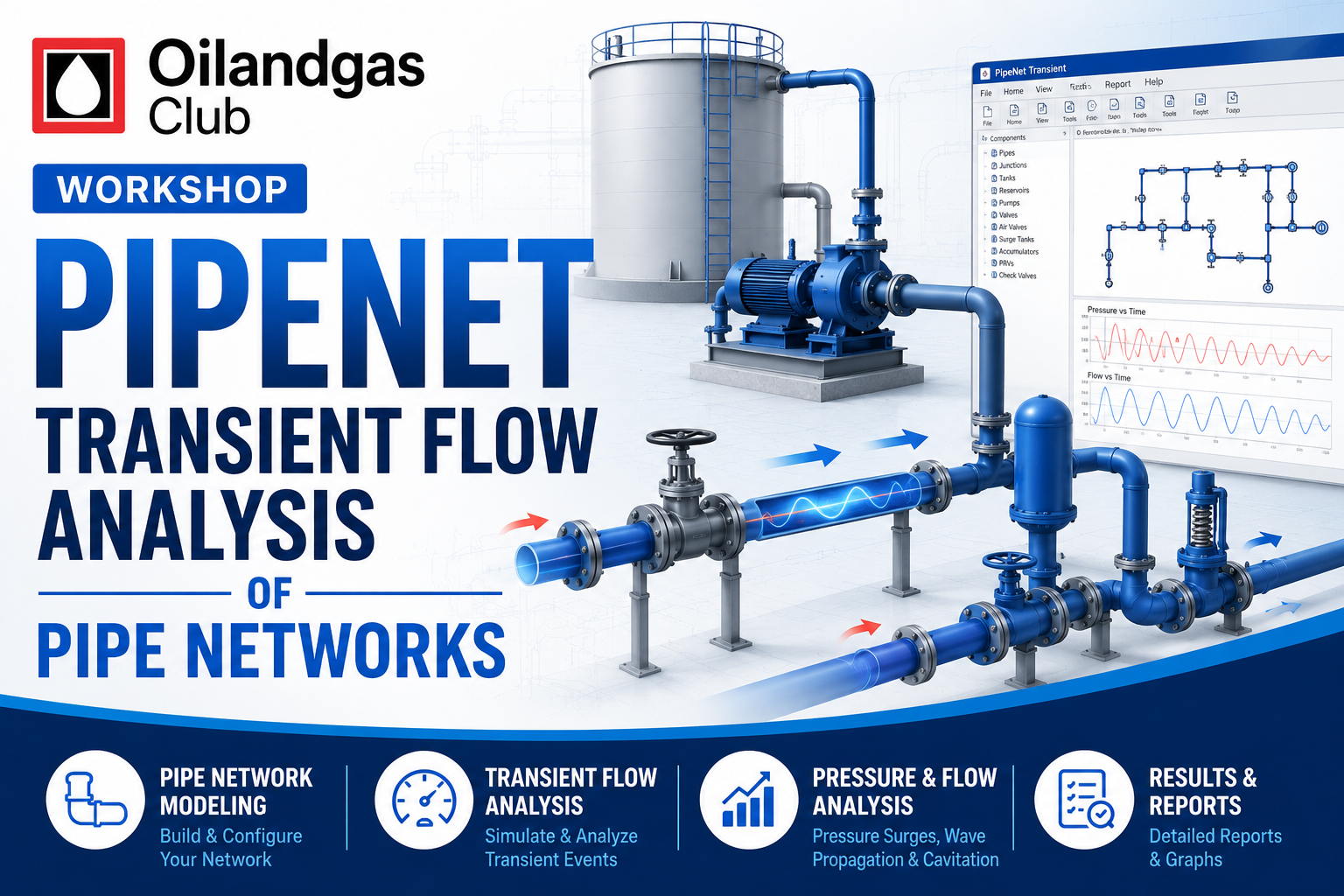
Starts Sunday, August 30, 2026 • 11am to 1 pm
Location Online
Duration2 Hours

Event snapshot

Date
Aug 30, 2026
Time
11am to 1 pm
Seats left
Limited
Language
English

Event Format

Skill level
All levels
Certification
Included
Mode
Hybrid

Last Few Seats Remaining – Register Today!

15Days
21Hours
19Mins
10Secs

About this event

PipeNet Transient Flow Analysis of Pipe Networks is a live, hands-on workshop that teaches engineers how to perform transient hydraulic analysis using PipeNet. Learn to simulate water hammer, pressure surges, pump trips, valve operations, and surge protection systems through practical exercises and a real-world industrial project.

What you'll learn

1. Topics Covered 2. What is Transient Flow? 3. Difference between Steady-State and Transient Analysis 4. Why Transient Analysis is Important 5. Understanding Water Hammer 6. Pressure Surge Fundamentals 7. Surge Wave Propagation 8. Positive and Negative Pressure Waves 9. Real Industrial Examples 10. Transient Events in Pipelines 11. Common Causes of Pressure Surges
1. Topics Covered 2. Pressure Wave Generation 3. Wave Speed Calculation 4. Pipe Elasticity 5. Fluid Compressibility 6. Joukowsky Equation 7. Pressure Rise Calculation 8. Reflection and Transmission of Pressure Waves 9. Cavitation 10. Vapor Pocket Formation 11. Column Separation 12. Surge Pressure Calculations 13. Critical Pipeline Length 14. Surge Duration
1. Topics Covered 2. PipeNet Transient Module Overview 3. Creating a New Transient Project 4. User Interface Walkthrough 5. Units Selection 6. Simulation Settings 7. Time Step Selection 8. Simulation Duration 9. Fluid Definition 10. Material Properties 11. Pipe Roughness 12. Pipe Wall Thickness 13. Wave Speed Settings 14. Saving and Managing Projects
1. Topics Covered 2. Importing Steady-State Model 3. Creating a New Network 4. Adding Pipes 5. Junctions 6. Tanks 7. Reservoirs 8. Pumps 9. Check Valves 10. Control Valves 11. Air Valves 12. Pressure Relief Valves 13. Surge Tanks 14. Accumulators 15. Boundary Conditions 16. Initial Conditions 17. Network Validation
1. Topics Covered 2. Pump Trip Simulation 3. Sudden Valve Closure 4. Gradual Valve Closure 5. Valve Opening 6. Pump Startup 7. Emergency Shutdown 8. Power Failure 9. Flow Changes 10. Demand Variations 11. Time-Based Controls 12. Event Scheduling 13. Trigger Conditions
1. Topics Covered 2. Selecting Solver 3. Time Step Selection 4. Numerical Stability 5. Simulation Execution 6. Monitoring Progress 7. Solver Warnings 8. Error Handling 9. Simulation Verification
1. Topics Covered 2. Pressure vs Time Graph 3. Flow Rate vs Time 4. Velocity Profile 5. Pressure Envelope 6. Maximum Pressure 7. Minimum Pressure 8. Surge Pressure Analysis 9. Water Hammer Detection 10. Cavitation Detection 11. Pump Performance During Transients 12. Valve Behaviour 13. Wave Propagation Visualization 14. Animation Review
1. Topics Covered 2. Air Vessel Design 3. Surge Tank Design 4. Pressure Relief Valve Selection 5. Surge Anticipation Valve 6. Vacuum Breaker 7. Air Release Valve 8. Check Valve Selection 9. Flywheel Application 10. Variable Frequency Drive (VFD) 11. Pump Control Strategies 12. Surge Mitigation Techniques
1. Project 2. Pump Shutdown Water Hammer Analysis 3. Participants will build and analyze a real industrial pipeline. 4. Project Includes 5. Create Pipeline Network 6. Storage Tank 7. Centrifugal Pump 8. Process Plant 9. Control Valve 10. Check Valve 11. Sudden Pump Trip 12. Observe Surge Pressure 13. Pressure Envelope Analysis 14. Cavitation Detection 15. Install Air Vessel 16. Re-run Simulation 17. Compare Before & After Results 18. Optimize Surge Protection
1. Topics Covered 2. Pressure Report 3. Surge Report 4. Pressure Envelope Report 5. Pump Report 6. Valve Report 7. Graph Export 8. Animation Export 9. PDF Report Generation 10. Design Validation 11. Common Modeling Mistakes 12. Best Engineering Practices 13. Industrial Design Recommendations
1. By the end of this workshop 2. participants will be able to: 3. Understand transient hydraulic phenomena and water hammer. 4. Build transient PipeNet models from scratch. 5. Import and extend steady-state models for transient analysis. 6. Simulate pump trips 7. valve operations 8. and emergency shutdown scenarios. 9. Analyze pressure surges 10. wave propagation 11. and cavitation risks. 12. Interpret transient pressure envelopes and time-history graphs. 13. Design and evaluate surge protection systems such as air vessels and surge tanks. 14. Troubleshoot transient hydraulic issues in industrial pipeline networks. 15. Generate professional engineering reports for design validation. 16. Apply transient analysis techniques to real-world oil & gas 17. water 18. and process industry projects.

Learners love the experience

Stories from professionals who moved ahead faster.

Ekta
Ekta
Process Engineer, ExxonMobil

“I attended the online workshop conducted by OilandGasClub and found it highly informative and well-structured. The sessions provided practical insights into current industry practices and emerging trends in the oil and gas sector. The speakers explained complex concepts clearly, making the workshop valuable for both experienced professionals and those looking to expand their technical knowledge. I appreciate the efforts of OilandGasClub in organizing such quality learning opportunities.”

Rupall
Rupall
Process Simulation Engineer, Shell India

“The OilandGasClub online workshop was an excellent platform for professional development. The content was relevant to industry requirements and covered important technical aspects with real-world applications. The interactive approach of the presenters kept the sessions engaging throughout. I would recommend these workshops to professionals seeking to enhance their understanding of oil and gas engineering practices.”

Nishant
Nishant
Mechanical & Static Equipment Engineer, Petrofac

“I had a great experience attending the online workshop organized by OilandGasClub. The workshop delivered valuable technical knowledge and practical perspectives from industry experts. The topics were thoughtfully selected and presented in a manner that encouraged active participation and learning. Such initiatives significantly contribute to continuous professional growth within the industry.”

Aparna
Aparna
Structural & Skid Design Engineer, TechnipFMC

“The online workshop conducted by OilandGasClub was insightful and professionally executed. The sessions offered useful knowledge on industry best practices and highlighted current developments in engineering and design within the oil and gas sector. The workshop environment encouraged learning and knowledge sharing, making it a worthwhile experience. I look forward to participating in more such programs in the future.”

Frequently asked questions

Who should attend this workshop?

This workshop is ideal for process engineers, piping engineers, pipeline engineers, mechanical engineers, design engineers, EPC professionals, engineering students, and anyone interested in learning transient hydraulic analysis using PipeNet.

Do I need prior PipeNet experience?

No. Basic knowledge of fluid flow and piping systems is helpful, but the workshop starts with the fundamentals before moving into advanced transient analysis.

Is this a live online workshop?

Yes. This is a live, instructor-led online workshop conducted through Microsoft Teams, where you can interact with the trainer and ask questions in real time.

Will I receive a certificate?

Yes. All participants who attend the workshop will receive a Certificate of Participation from Oilandgasclub.

What software is used during the workshop?

The workshop uses PipeNet software to perform transient flow analysis, including water hammer, pressure surge, pump trip, and valve operation simulations.

Will there be a hands-on project?

Yes. The workshop includes a practical hands-on project where you'll build and analyze a transient pipe network model using real engineering scenarios.

What is the duration of the workshop?

The workshop duration is 2 hours, including live demonstrations, practical exercises, and a Q&A session.

What language will be used for instruction?

The workshop will be conducted entirely in English.

How can I register for the workshop?

You can register online through the Oilandgasclub website. After successful registration, you'll receive confirmation and joining instructions via email.

Can students attend this workshop?

Absolutely. Engineering students and fresh graduates are encouraged to join to gain practical industry knowledge and improve their employability.

How can I contact the organizer?

You can reach the Oilandgasclub support team through the contact details available on our website or by emailing our support team for any registration or technical queries.

What are the learning outcomes?

By the end of this workshop, you will be able to: Understand transient hydraulic analysis fundamentals. Perform water hammer and pressure surge analysis. Simulate pump trip and valve closure scenarios. Evaluate surge protection methods. Build and analyze PipeNet transient models. Interpret simulation results and troubleshoot hydraulic systems.

Do I need a powerful computer to attend?

No. A standard Windows laptop or desktop with a stable internet connection is sufficient for attending the live workshop. Running PipeNet alongside the session is recommended but not mandatory.

Why should I attend this workshop?

This workshop provides practical, industry-focused training through live demonstrations and real-world case studies. You'll gain hands-on experience with PipeNet Transient Flow Analysis, enhance your hydraulic analysis skills, earn a certificate, and strengthen your profile for careers in the oil & gas, process, water, and pipeline industries.

More events you’ll like

Earn A Career Certificate

  • Add this credential to your LinkedIn profile, resume, or CV
  • Share it on social media and in your performance review
SAMPLE

CERTIFICATE

of Completion

This Certificate is Proudly Presented to the honorable achievement to

PARTICIPANT NAME

Has successfully completed the training program of PipeNet Transient Flow Analysis of Pipe Networks. The Program has Conducted during the period of 30 Aug 2026 to 30 Aug 2026.

₹12,000 onwardsAvailable